There’s a Chemical Doing Heavy Work Across Dozens of Industries — and Most People Have Never Heard of It
From the sour gas processing units running in Abu Dhabi’s oilfields to the textile finishing lines producing performance fabrics in Asia, from automotive antifreeze formulations to industrial cleaning products used in hotels and food processing plants across the UAE — one chemical keeps showing up: Monoethanolamine.MEA is one of those industrial workhorses that rarely gets the recognition it deserves. If you’re sourcing chemicals for Middle East and Africa Oilfield Chemicals applications, managing a textile plant, or formulating specialty industrial products, MEA is likely already in your supply chain. In this post, we explore why it’s so widely used, how it performs in key applications, and why Corofy has become a trusted monoethanolamine manufacturer and supplier for clients across the UAE and GCC
What Is Monoethanolamine (MEA)?
Monoethanolamine — also written as Ethanolamine or 2-aminoethanol — is a
bifunctional organic compound containing both a hydroxyl group (-OH) and a primary amine group (-NH₂). That dual chemistry is exactly what makes MEA so unusually versatile: the amine group reacts with acid gases, while the hydroxyl group gives it excellent water solubility and surfactant-compatible behaviour.
It presents as a clear, slightly viscous liquid with a faint ammonia-like odour, and is fully miscible with water — making it easy to formulate, blend, and dilute to application-specific concentrations
| Property | Value |
|---|---|
| Molecular Formula | C₂H₇NO |
| Molecular Weight | 61.08 g/mol |
| Boiling Point | 170°C |
| Density | 1.018 g/cm³ at 20°C |
| Appearance | Clear to pale yellow viscous liquid |
| Odour | Faint ammonia-like |
| Miscibility | Fully miscible with water |
MEA in Middle East and Africa Oilfield Chemicals: Gas Treating and Sweetening
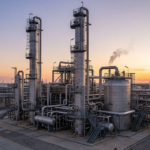
For anyone working in Middle East and Africa Oilfield Chemicals, MEA’s most critical application is acid gas removal — commonly known as gas sweetening. Natural gas from the reservoir typically contains carbon dioxide (CO₂) and hydrogen sulphide (H₂S). Both are corrosive, both are toxic, and both need to be removed before the gas can be transported through pipelines or exported
In an MEA gas treating unit, sour gas enters an absorber column and contacts a flowing stream of lean MEA solution. MEA chemically reacts with CO₂ and H₂S, binding them into water-soluble salts that travel with the rich amine to a regenerator. Heat in the regenerator strips the acid gases, restoring lean MEA for recirculation. The result is clean, sweetened gas that meets pipeline and LNG export specifications
As a key component in Oil Drilling Chemicals supply chains — and increasingly in CO₂ capture systems for industrial decarbonisation — MEA’s role in the regional energy sector is only growing
Key advantages of MEA in gas treating:
- Fast reaction kinetics with CO₂ and H₂S, even at low partial pressures
- High removal efficiency for both acid gases simultaneously
- Decades of proven operational performance across GCC facilities
- Cost-effective for high-CO₂ concentration gas streams
- Well-supported by established supply chains and technical service networks
MEA as a Textile Finishing Chemical
MEA’s contribution to the textile industry is less headline-grabbing than its oilfield role, but it’s commercially significant — particularly for manufacturers serving export markets where fabric quality standards are exacting. As a textile finishing chemical, MEA is used at multiple stages of fibre processing:
- Scouring and preparation — MEA adjusts bath pH to remove natural waxes, oils, and
impurities from raw fibre before dyeing, ensuring even colour uptake
- Mercerising — alkaline MEA solutions are applied to cotton to improve tensile
strength, lustre, and dye affinity
- Dyeing auxiliaries — MEA stabilises pH in dye baths, improving colour fastness and batch-to-batch consistency
For UAE textile processors and chemical formulators supplying the textile finishing chemical market across Asia and Africa, having a reliable, regional MEA source in Dubai removes a significant logistical and cost variable
MEA in Antifreeze and Automotive Coolants
MEA appears in some Antifreeze and engine coolant formulations as a corrosion inhibitor and pH stabiliser. Over time, coolant systems accumulate acidic degradation products that attack aluminium engine blocks, copper radiators, and iron components. MEA neutralises these acids and buffers the system pH, extending the service life of both the coolant and the engine hardware it protects
For automotive chemical formulators in the UAE — whether producing OEM-specification coolants or aftermarket maintenance products — MEA is a value-adding formulation ingredient worth evaluating
MEA in Coatings and Corrosion Inhibition
In waterborne paints and industrial coatings, MEA functions as a neutralising agent and emulsion stabiliser. It adjusts the pH of waterborne alkyd and acrylic systems, improving shelf stability, flow, and adhesion — without the solvent loading of traditional approaches. This makes MEA especially relevant in the UAE’s construction and industrial maintenance coatings sectors, where waterborne formulations are gaining ground for environmental and regulatory reasons
MEA in Industrial Cleaning and Detergents
MEA’s surfactant-building properties and strong grease-cutting ability make it a practical ingredient in heavy-duty industrial cleaners, floor degreasers, and institutional cleaning products. The UAE’s food processing, hospitality, and facilities management sectors all consume significant volumes of MEA-based cleaning formulations
MEA in Agriculture
Ethanolamine derivatives are used as intermediates in the synthesis of herbicides and crop protection chemicals, and as emulsifiers in agricultural spray formulations. As the UAE and wider GCC continue to invest in domestic food production and agricultural self-sufficiency, regional demand for agricultural chemical intermediates like MEA is growing.
Why Source MEA from Corofy?
Corofy works with clients across the full range of MEA applications — from large
petrochemical operators running gas treating units to specialty chemical formulators developing new cleaning and coating products. What they all have in common is the need for consistent quality, full documentation, and a supplier who picks up the phone.
As a monoethanolamine manufacturer and supplier based in Dubai, here’s what Corofy delivers:
- Industrial-grade MEA with consistent purity specifications
- ISO 9001:2015 certified supply chain
- Full documentation: CoA, SDS, TDS on every order
- Regional expertise in Middle East and Africa Oilfield Chemicals and Oil Drilling
Chemicals applications
- Flexible packaging: drums, IBCs, and bulk quantities
- Delivery across UAE, Saudi Arabia, Oman, Qatar, Bahrain, and Kuwait
Storage and Safety
MEA is a mildly corrosive substance and should be stored in sealed, labelled containers away from strong acids, oxidising agents, and heat sources. Chemical-resistant gloves, eye protection, and appropriate respiratory protection should be worn when handling. For full handling, storage, and emergency response guidance, refer to the product Safety Data Sheet
Let’s Talk About Your MEA Requirements
Whether your application is gas treating, textile finishing, antifreeze production, coatings formulation, or specialty cleaning, Corofy’s technical team is ready to help you find the right grade, the right volume, and the right supply arrangement. Contact us today or request a quote from our website — we’ll respond within one business day